

Context management architecture and responsibilities
This page explains the responsibility of each component in context management and how evidence becomes reusable artifacts. It is a cross-workflow architecture guide; use the individual artifact pages for concrete write, review, and retrieval procedures.
How context is created and used
Where data belongs
A Scope defines data ownership and access control for its Sources, Artifacts, Candidates, and processing state. The outer box represents one Scope; the arrows inside it describe how content is formed.
How content is formed
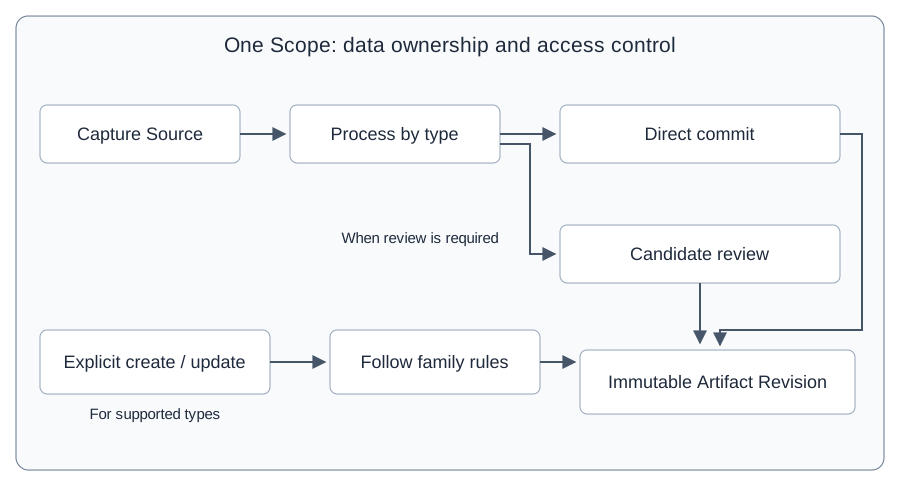
Sources preserve evidence. Processing evidence and committing an artifact are separate actions: capture does not mean generation has finished, and generation does not necessarily mean approval. Types that support explicit creation or updates can also accept content without automatic extraction.
- Generated Experience and Skill proposals require Candidate review before commit. Direct Artifact Create/Replace can commit a validated payload as a formal Revision immediately; these endpoints do not create a Candidate automatically.
- Profile policy selects automatic commit or review; manual creation and replacement are also supported.
- Memory and Topic Memory commit according to their processing rules; Topic Memory does not support manual creation or updates.
- Handoff commits through the work continuity workflow; Prompt is managed through configuration APIs.
A successful commit creates an immutable Artifact Revision. See each type's guide for permissions, version checks, and generation requirements.
How artifacts are used
| Purpose | Content and operation |
|---|---|
| Provide context for the current task | Memory, Experience, Profile, Topic Memory → select under recall and assembly rules → PreparedContext |
| Continue work across sessions | Handoff → read the transfer → continue the task |
| Make a Skill discoverable by a host | Skill → export a specified approved Revision → host-local Skill |
| Adjust generation behavior | Prompt → prompt configuration used by the corresponding operation |
| Find and trace content | Filter content that supports tags; read history by exact Revision |
These are parallel uses. Handoff is itself an Artifact family; PreparedContext is temporary output for one request. Not every family enters PreparedContext automatically: Profile requires explicit selection, while Skill and Handoff have their own consumption paths.
Where components run
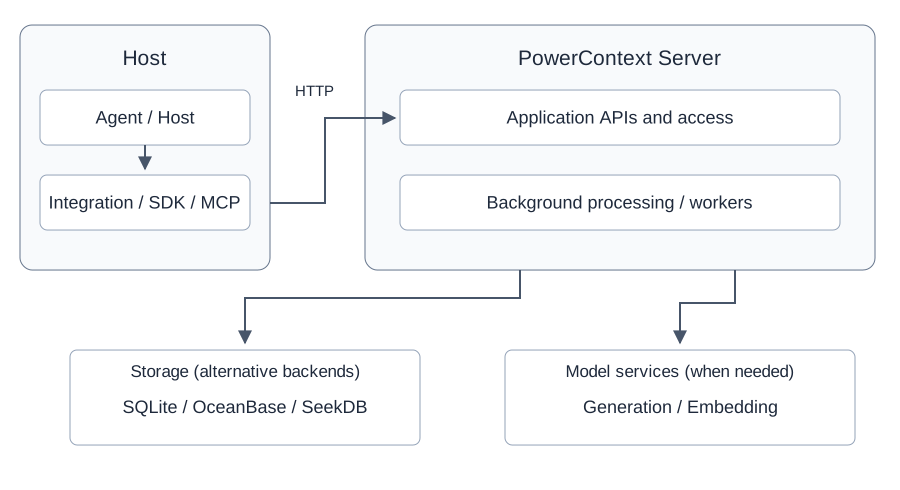
The Agent and integrations run on the host and connect to PowerContext Server over HTTP. The Server owns application APIs, authorization, and background processing. Workers are logical responsibilities in this diagram, not a requirement to deploy another service. The Server calls configured generation or embedding models when needed. SQLite uses a local data file; OceanBase / SeekDB uses a configured database connection. The storage box represents alternative backends.
See deployment and operations for deployment settings, service checks, and recovery procedures.
Component and responsibility boundaries
| Component or role | Owns | Does not own |
|---|---|---|
| Agent / Host | Submits requests and decides when to save, hand off, or use context | Extra execution authority because content was recalled |
| HTTP, MCP, Python Client, and CLI | Projects different integrations onto one Server contract | An assumption that every integration exposes the same capabilities |
| PowerContext Server | Resolves Scopes, enforces access, and serves Source, Artifact, and PreparedContext APIs | User authorization decisions for the Agent |
| Runtime / background workers | Generates Memory, Experience, Skill, Profile, or Topic Memory from eligible Sources | Bypassing Candidate review or treating generated content as an execution command |
| Review / projection | Reviews Candidates or exports an exact approved Skill Revision to a host | Rewriting historical Revisions, installing, or executing a Skill automatically |
| Database and persistence layer | Stores Scopes, Sources, Artifact Revisions, and processing state | The deployment layer's backup and recovery policy |
Model generation, human review, and execution authority are separate boundaries. Proposals requiring review commit after
approval; direct Create/Replace commits a validated Revision under the caller's governance policy. Export creates a
host-local copy without granting execution authority. PreparedContext is temporary for one Agent turn, not a new Artifact.
Content types currently supported
| Type | Purpose and current lifecycle | What happens next |
|---|---|---|
| Scope | Isolates Sources, artifacts, Candidates, and runtime state while carrying access policy | Resolve a Scope before every content operation |
| Source | Stores captured evidence or references to external material | Read explicitly, or process asynchronously through a configured pipeline |
| Memory | Stores facts, decisions, constraints, state, and next steps; retire removes active recall but preserves history | Write explicitly or extract from Sources, then retrieve |
| Experience | Records a reusable situation, action, outcome, and lesson | Generated proposal: proposal → Candidate → review → approved Revision → PreparedContext recall; direct write: Create/Replace → Revision |
| Skill | Stores an exportable name, description, instructions, validation checks, and lineage | Generated proposal: proposal → Candidate → review → exact export to a host; direct write: Create/Replace → Revision → exact export |
| Profile | Stores stable Scope background and subject information | Generate from subject Sources or policy, then review, replace, or roll back by appending a Revision |
| Topic Memory | Incrementally derives topic summaries from long-running Sources with progressive detail | Request flush, search current heads, then get an exact Revision |
| Handoff | Records task boundaries, transfers, and milestones | prepare → optional commit → receiver acknowledgement / outcome |
| Prompt | Scope-level operational prompt configuration, not factual evidence and not ordinary recall | Manage with scope.admin access |
| Tag | Filterable metadata for Memory, Experience, Skill, and Handoff | Manage through tag APIs; it is not an Artifact family |
The code enum for write-capable Artifact families is memory, experience, skill, handoff, profile, and prompt.
Artifact reads also expose the specialized topic-memory family. Topic Memory currently has no generic create, update,
delete, or retire API.
Current data governance and recovery boundary
The implementation currently provides these consistency and boundary controls:
- Scope-level access control, plus
expected_versionand ETag /If-Matchconcurrency protection on writes; - immutable Artifact Revisions and exact references, Memory
retire, and Profile replacement or rollback by appending a Revision; - isolation between pending, approved, and rejected Candidates so unreviewed content does not enter Artifact retrieval or
PreparedContext.
There is no generic user-level Artifact delete, TTL/retention policy, export/import, or one-click Scope restore API today; Topic Memory also has no manual delete endpoint. Operators can back up the database or data directory using the Server deployment backup principles, then restore or migrate it using troubleshooting and migration. Those are operational responsibilities and should stay outside the context management data lifecycle.